
Place a palm at a register and the air feels thin, while the indoor cabinet shows a damp ring at its seams or a white crust on the cold line.
State · ac unit repair
AC Repair in New Jersey
Thin air at the registers, a damp ring on the indoor cabinet or a white crust on the cold line means you need AC repair in New Jersey before the next cooling cycle runs. One free call connects you with a local AC repair specialist, and any hiring decision remains yours.
Local conditions
What shapes AC repair in New Jersey
Heat and humidity
ClimateNew Jersey's average temperature from June through August was 73.1 degrees Fahrenheit across the 30 years from 1991 to 2020. Source: NOAA National Centers for Environmental Information, Climate at a Glance, Statewide Time Series (mean of the yearly June-August values 1991-2020), retrieved 2026-11-16.
Warm summers run the unit for long stretches, so a failing part shows up as a unit that runs without ever reaching the set temperature.Housing stock
HousingThe median housing unit in New Jersey was built in 1971, and 61 percent of the state's housing units were built before 1980. Source: U.S. Census Bureau, American Community Survey (ACS 2024 1-year), tables B25035 and B25034, as published by Census Reporter, retrieved 2026-11-12.
Older homes have had more years of cooling-system wear, and an aging outdoor unit or indoor drain path is where repairs concentrate.State HVAC rules
State rulesNew Jersey's State HVACR examining board, part of the Division of Consumer Affairs, requires a state license to work as a master in the HVACR trade (N.J.S.A. 45:16A-7), and the board's site carries a license verification page. Source: New Jersey Division of Consumer Affairs, State HVACR examining board, Frequently Asked Questions page citing N.J.S.A. 45:16A-7, retrieved 2026-11-16.
A New Jersey owner can verify an AC repair business with the state board before work begins.Check your ZIP code
Enter the ZIP code of the property to see whether it is in the coverage area for ac unit repair connections.
Call (310) 424-7490What you are seeing
Weak Air and a Damp Ring at the Indoor Cabinet
The thermostat keeps calling for cooling, yet rooms drift upward through the late day. That pairing points to an evaporator coil below freezing, with a sheet of ice choking off the air that feeds it.
Mention which vents breathe weakest and whether your outdoor fan blade is spinning, since those observations steer the first measurements. That coil condition is the one behind AC freezing up, and the stalled temperature in your rooms echoes AC not cooling.
What waiting costs
Why a Temperate Summer Chills the Coil Too Far
NOAA's 1991-2020 climate record sets the New Jersey June-to-August mean at 73.1°F. Cooler mornings and evenings under that mean give the system a light load, so the coil sinks lower than it does during a heat wave.
A coil stays above freezing only while enough indoor air sweeps across its fins. Starve it with a slipping blower, a matted coil face or a pinched return grille, and the surface drops under 32°F while condensation on the fins turns to rime at each pass.
Each layer of rime narrows the gaps between fins, and the narrower gaps grow ice faster. Your compressor keeps running against a coil that pulls in almost nothing, which strains its windings and your utility bill.
Housing and heat
What a Choked Coil Takes From Your House
Rooms hold their heat for hours while the system works, and all that run time grinds on your compressor and fan motors with no cooling in return. Your bill keeps climbing for a house that still sits above its setpoint.
When the rime softens, the runoff outpaces its exit route and reaches the cabinet's electrical section, the framing around the air handler and the rooms below. A symptom you spot midweek began days earlier, and it is the loss behind AC leaking water.
Thin air or a damp ring at your cabinet? Call to connect with a local AC repair specialist.
(310) 424-7490Repair scope
AC Unit Repair That Starts With the Air Path
Professional AC unit repair in New Jersey begins by finding why air stopped crossing the coil, not by chipping at the ice. Pressure and flow readings at the supply registers, the return grille, the blower wheel and the coil face distinguish a sluggish motor from a matted coil and from a choked return. A slab of ice hides the true state of the fins, so the coil is brought back to bare metal before any verdict.
Electrical testing comes next, from the run capacitor to the control board, because a part that bogs down the blower grows the same ice. The finish is a sustained cooling run with steady air at the registers, a dry cabinet and a coil face that stays bare to the last minute of the test.
Local detail
New Jersey Housing Built Before 1980
Census figures for 2024 place the midpoint New Jersey home in 1971, with 61% of the state's housing units older than 1980. Homes that old have run through many summers, and repairs pile up at the outdoor unit and the indoor drain path.
Leave it switched off
Stop the Cooling Call and Stay Clear of the Cabinet
Switch your thermostat to off the moment ice or a damp ring appears, and keep your hands clear of the coil, the access panels and the lines. Prying at ice bends the fins and kinks the tubing, and a wet cabinet puts you near energized parts, so place your call from across the room.
How the call works
From One Cool Evening to Damage Below
The first crust forms on a cool night and drains away by sunrise, so nobody registers it. Within a handful of cycles it outlasts the off period, your vents push less each day and your thermostat keeps asking for more.
By the time damage shows in the rooms below, the coil has been blocked for a long stretch. A call at the first damp ring confines the work to the air fault, and each extra stretch of waiting adds a moisture job to your repair.
Drying verified
The State HVACR Board and Your Hiring Choice
The State HVACR examining board sits inside the Division of Consumer Affairs, and N.J.S.A. 45:16A-7 calls for a state license to work as a master in the HVACR trade. A license verification page on the board's website lets you look a name up.
Search a name there before any work begins. The firms on the other end of your call act on their own, apart from this connection, so the check is yours to make, and a free call through the national AC repair line opens your options.
Common questions
Questions About AC Repair in New Jersey
Why does my AC run all day and still feel weak at the registers?
A coil sheathed in ice passes little air, so the system runs long while rooms barely cool. The air conditioner repair that follows measures flow at the supply registers, the blower and the return grille to name the cause.
Does New Jersey require a license for HVACR work?
Yes, for a master in the HVACR trade: N.J.S.A. 45:16A-7 calls for a state license, and the board's website offers a verification page. Using it is your task, because the specialists on the line act on their own.
Does the age of my New Jersey home change where AC repair lands?
Yes. A midpoint build year of 1971 steers repairs toward the outdoor unit and the indoor drain path.
Should I wait for the ice to melt before I call?
No. Set your thermostat to off, leave your coil alone and call, because melting ice overruns its exit route and soaks the rooms below.
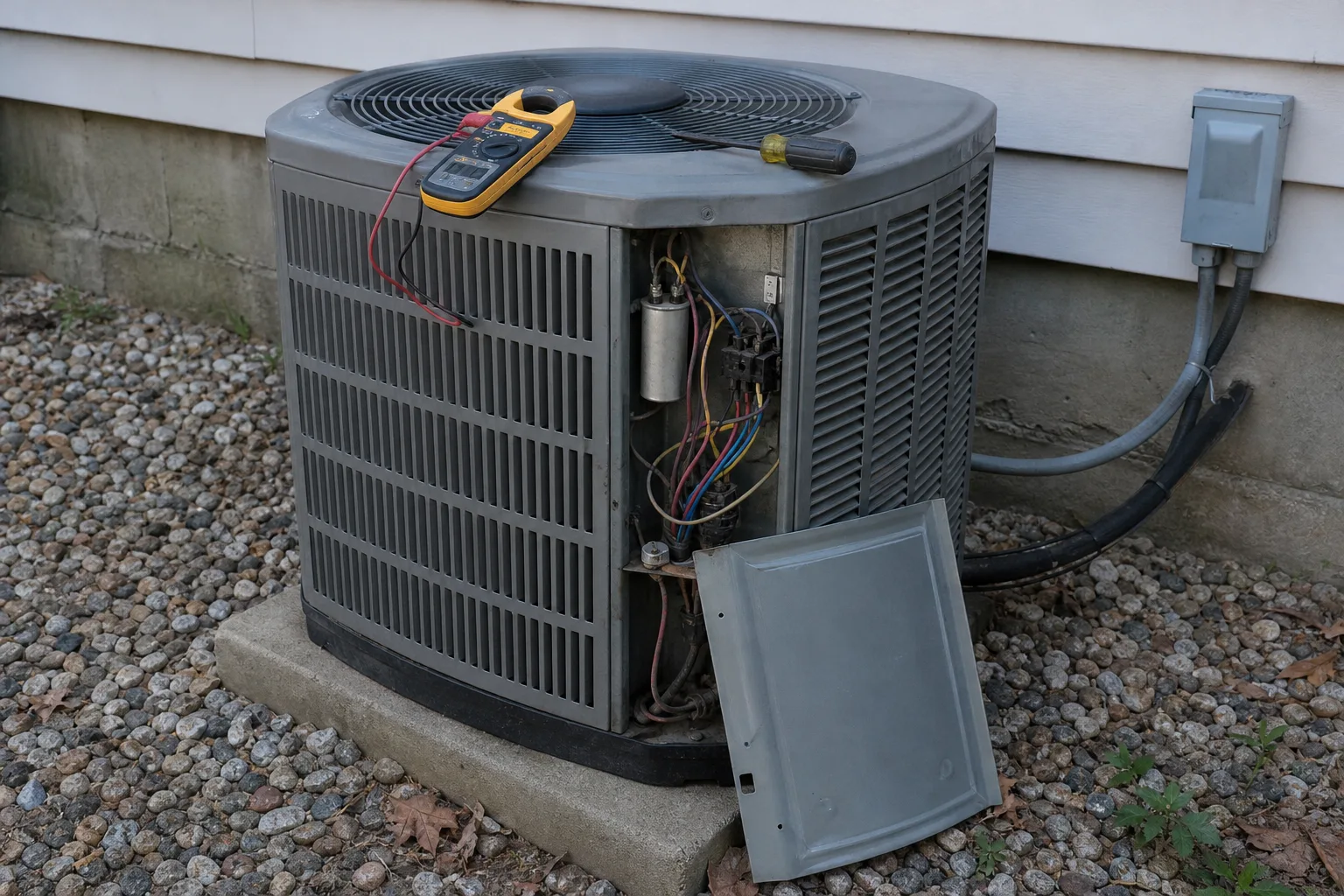
A failed part keeps damaging the unit while it runs.
Call before the compressor, the outdoor fan motor or the ceiling below the unit takes the damage.